Net worth tracker

Net Worth View

Data

Your data

Changes save automatically in this browser.

Complete backup

JSON

All your records and settings in one file you can restore later.

Spreadsheets

CSV

Balances and cash flow only. Importing adds records to your data.

Loading your finance tools…

Understand what you own and owe

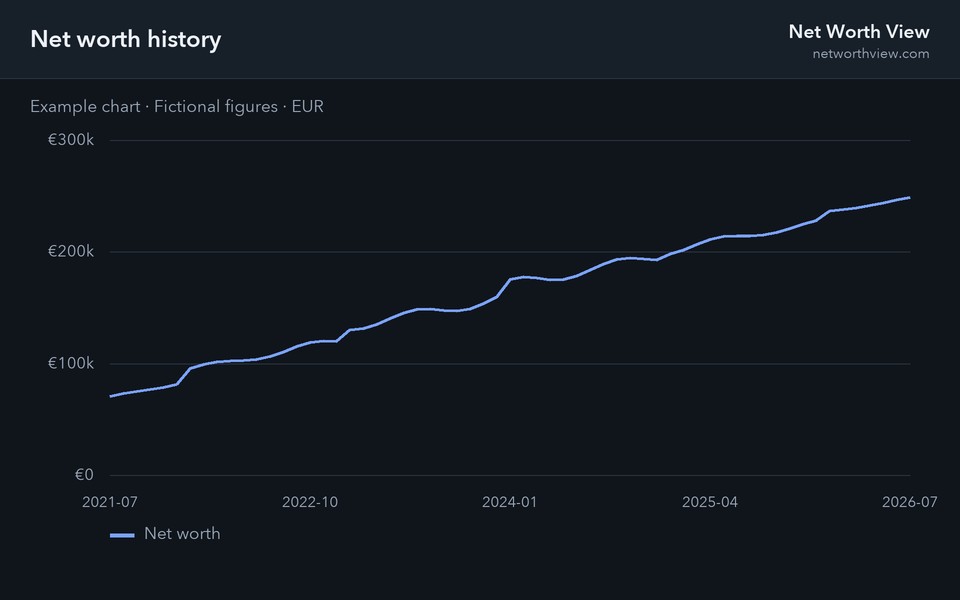
Net worth is included assets minus included liabilities. Enter debts as positive balances; the tracker subtracts them. Account and asset-class charts show the composition of your wealth. Scope controls let you exclude property, pensions or liabilities without deleting records.

The change since your previous snapshot is a simple difference. Year-over-year growth compares your latest snapshot with the available snapshot nearest to one year earlier. Annualised growth is a separate compound annual growth rate over your full snapshot history, shown when the starting and ending values are positive and there is sufficient history.

Currency conversion uses rates saved with each snapshot where available. Historical lookup can fall back to current rates, and imported records may have no captured rates. Treat conversions as estimates and check the methodology before comparing balances across currencies.
How to track your net worth

  1. Choose New account for each place you hold or owe money, such as a current account, a brokerage account, a workplace pension, your home or a mortgage, and set the currency it is held in.
  2. Choose Add snapshot, pick a date and enter each account’s balance on that day. Earlier snapshots keep their figures, so your history builds up instead of being overwritten.
  3. Repeat monthly, quarterly or whenever suits you. The net worth chart, allocation breakdown and growth figures fill in as snapshots accumulate.
  4. Download a complete backup after each update, or Download CSV to open your balances in a spreadsheet. Your records live only in this browser.

Which account type to choose

Cash
Current and savings accounts, fixed-term deposits and an emergency fund: money you can reach quickly at a stable value.
Investment
Brokerage and fund accounts, stocks and shares ISAs, bonds and crypto held outside a pension. Their value moves with markets.
Pension
Workplace and personal pensions, 401(k)s and IRAs. Record the current pot value; the projection can hold a pension back until its access year.
Property
Your home, a rental property or land at an estimated market value. Record the mortgage as a separate liability so the chart shows your equity.
Liability
Mortgages, car finance, student loans and credit-card balances, entered as the positive amount you still owe.

Keeping snapshots comparable

Record balances on roughly the same day each time, for example once salary and the major bills have cleared. A snapshot taken on payday and one taken before rent is due can differ by a whole pay cheque with no real change in your wealth.

Estimated values such as a home move in large, irregular steps. Updating a valuation once or twice a year, and viewing totals with property excluded, keeps a revaluation from masking what your regular saving is doing.

A defined-benefit pension has no pot to record. Some people enter its transfer value and others leave it out; whichever you choose, keep to it so the trend stays meaningful.